

Why I left HR to help people land remote jobs instead
I spent years hiring people before I decided to switch sides. Here's what I learned from recruiting remote employees, why I left HR & how that experience has helped hundreds of people land remote jobs

One of the biggest turning points in my career happened because I asked myself a really simple question.
If I know exactly what recruiters and hiring managers are looking for... why am I keeping that information to myself?
For years, I was on the hiring side (hiring for remote opportunities, and doing it remotely, as well).
I spent my days reviewing resumes, interviewing remote candidates and trying to figure out who would be the best fit for the company. I saw what made someone stand out, what made a recruiter stop scrolling and what made someone get invited to an interview instead of being overlooked.
And after doing that hundreds and hundreds of times, I realized something that completely changed the direction of my career.
Most people don’t get rejected for remote jobs they want because they aren’t qualified.
They get rejected because they don’t know how to communicate that they are.
A lot of you have the skills, the experience, and some of you have even worked remotely before.
But none of that is obvious from the way you are presenting themselves when applying for remote jobs.
That’s when I started thinking...
“If I’ve spent years learning how this whole process works, maybe my job isn’t just to hire people anymore.”
Maybe my job is to teach people how to get hired.
That thought eventually became my entire content strategy on socials, and later… my whole business.
It’s the reason I started sharing remote jobs back in 2019 on Instagram stories at first. It’s the reason I built my remote job directory. It’s the reason I created workshops, templates, guides, this Substack, my YouTube channel and even a full course that breaks down exactly how to do it.
Because I know what one remote job can do. It completely changed my life.
And after helping hundreds of people land remote jobs over the last few years, I’ve seen it change theirs too.
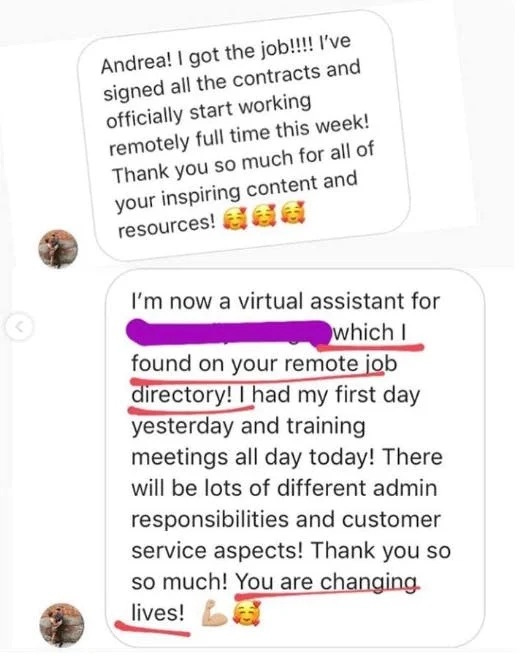
So today I want to tell you the story of how I went from being the person hiring remote employees... to becoming the person helping people land those jobs instead. I don’t think I’ve ever shared the full story from beginning to end, and I have a feeling it’ll make a lot of things click if you’ve ever wondered why I’m so obsessed with teaching remote work.
A little about me, in case you’re new here
Hi! I’m Andrea Valeria, and I’ve been working remotely since 2015.
Before I started teaching people how to find remote jobs, I was actually the person doing the hiring.
I spent a few years working in Human Resources, and eventually I became the hiring manager for a company with employees across multiple states in the US. Then, back in 2015, I became that company’s very first remote employee. I continued doing the same recruiting, interviewing and hiring I had been doing in the office... just remotely.
I didn’t know it at the time, but those years completely shaped everything I do today.

After reviewing hundreds of resumes and interviewing candidate after candidate, I started noticing the same patterns over and over again. So many people had the skills to get hired, but they weren’t communicating those skills in a way that recruiters could actually see. They were getting overlooked not because they weren’t capable, but because they didn’t know how to present themselves for remote jobs.
That realization stuck with me.
And when I started sharing my own remote work journey on social media, people naturally began asking me how they could find remote jobs too. One question turned into another, and before I knew it, helping people go remote had become my full-time mission.
That’s because I genuinely believe that your first remote job can change your life.
I’ve seen it happen in my own life, and over the years, I’ve had the privilege of watching it happen for hundreds of other people too. That’s why I keep showing up and sharing everything I’ve learned. I don’t believe in gatekeeping information that can help someone build a better life. If I know something that can make your remote job search easier, I’d much rather put it out into the world than keep it to myself.
When I first started working in Human Resources, I had no idea it would eventually lead me here.
Like a lot of careers, mine evolved naturally. I didn’t get hired specifically to recruit people. Little by little, I started taking on more responsibilities until interviewing candidates, reviewing resumes and hiring employees became the main part of my job.
Eventually, I became the hiring manager for a company with employees across multiple states in the US, and every day I found myself doing what recruiters everywhere do: trying to figure out who would be the best fit for the company.
Then, in 2015, something happened that completely changed the trajectory of my own career.
I became the company’s very first remote employee.
Nowadays, that probably doesn’t sound like a big deal. Remote work is something we’re all familiar with. Back then, though, it felt completely different. This was years before the pandemic, before Zoom became part of everyone’s daily vocabulary and before most people even knew someone who worked remotely.
What’s funny is that my job didn’t actually change all that much.
I was still recruiting. Still interviewing candidates. Still reviewing resumes. Still hiring people. The only real difference was that I was now doing everything online instead of from an office.
That experience taught me one of the biggest lessons I still share with people today btw.
One of the most common misconceptions I hear is that if you want a remote job, you have to completely reinvent yourself. People tell me all the time that they think they need to learn coding, become a graphic designer, work in social media or somehow switch industries before they’ll have a chance of getting hired remotely.
But that’s almost never true.
I didn’t become a different professional when I started working remotely. I simply learned the tools that allowed me to do the exact same job I’d already been doing. Instead of interviewing someone across a desk, I interviewed them over Skype (I didn’t know of Zoom back then). Instead of collaborating in person, I collaborated through digital tools. Instead of handling everything face-to-face, I learned how to do it online.
That was it. The work stayed the same. The tools changed.
I think that’s something people don’t realize about fully remote companies. They don’t just hire software engineers or designers. They need HR professionals, accountants, customer support representatives, recruiters, lawyers, marketers, project managers... every department that exists in a traditional company also exists in a remote company. The opportunity isn’t limited to one industry. It’s simply a different way of doing the same work.
Once I understood that myself, I started seeing remote work very differently. But the biggest lesson wasn’t about my own career.
It came from the people I was hiring.
There were so many people who were genuinely qualified... but you never would’ve known it from reading their resume.
Sometimes I’d read someone’s application, think they weren’t quite what we were looking for, and then click over to their LinkedIn profile out of curiosity. Suddenly I’d discover projects, experience or skills that completely changed my perception of them—things that should have been front and center on their resume but weren’t mentioned at all.
Other times, I’d realize someone had actually worked remotely before. Now, I see that with people who worked remotely during the pandemic, but don’t mention it on their resume. Some candidates have spent months or even years collaborating with virtual teams, attending online meetings, managing projects digitally and communicating through remote work tools, yet none of that appeared in the document that is supposed to convince someone to hire them for a remote job.
It was like they were hiding their best qualifications for remote work.
If someone truly isn’t qualified for a role, that’s one challenge.
But if someone already has what it takes and simply doesn’t know how to present themselves? That’s a problem you can solve (that’s the good news!)
Every day (back then), I walked away feeling like there was this huge gap between what recruiters knew and what job seekers knew. I understood exactly what employers were looking for because I was sitting on that side of the hiring process. Meanwhile, so many talented people were applying without realizing they were making small, fixable mistakes that were costing them interviews.
I started thinking, If I know what recruiters are looking for... why am I keeping that information inside the recruiting department?
I could continue helping companies hire great people, or I could take everything I’d learned from years of recruiting and use it to help those great people get hired instead.
That second option felt a lot more meaningful.
So little by little, that’s exactly what I started doing.
Back in 2016, I began sharing bits and pieces of my own remote work journey online. At first, people were mostly interested in the lifestyle. They wanted to know what it was like to work while traveling, how I managed to stay productive from different places, and whether remote work was really as flexible as it looked.
But over time, the questions changed.
People stopped asking me where I was traveling and started asking me where I had found my remote job. They wanted to know if they could do the same thing, whether companies actually hired people outside the United States, and how someone with their background could get started.
That’s when I realized people didn’t just want inspiration… they wanted direction because they wanted to do the same (rightfully so!).
So I started creating the kinds of resources I knew they needed at the beginning of their remote job searches.
I built this remote job directory to help people find legitimate companies instead of wasting hours scrolling through scams. I started sending a weekly newsletter with remote jobs. You can subscribe here.
I created workshops, YouTube videos, guides, templates and eventually my course, Land Your First Remote Job, because I wanted to have one place where I could teach everything I’d learned over the years. Watch intro training to remote job and my course HERE.
So, from the start I knew I wanted to build a library of resources that would help people get remote jobs.. which is something that I have also done now in this Substack.
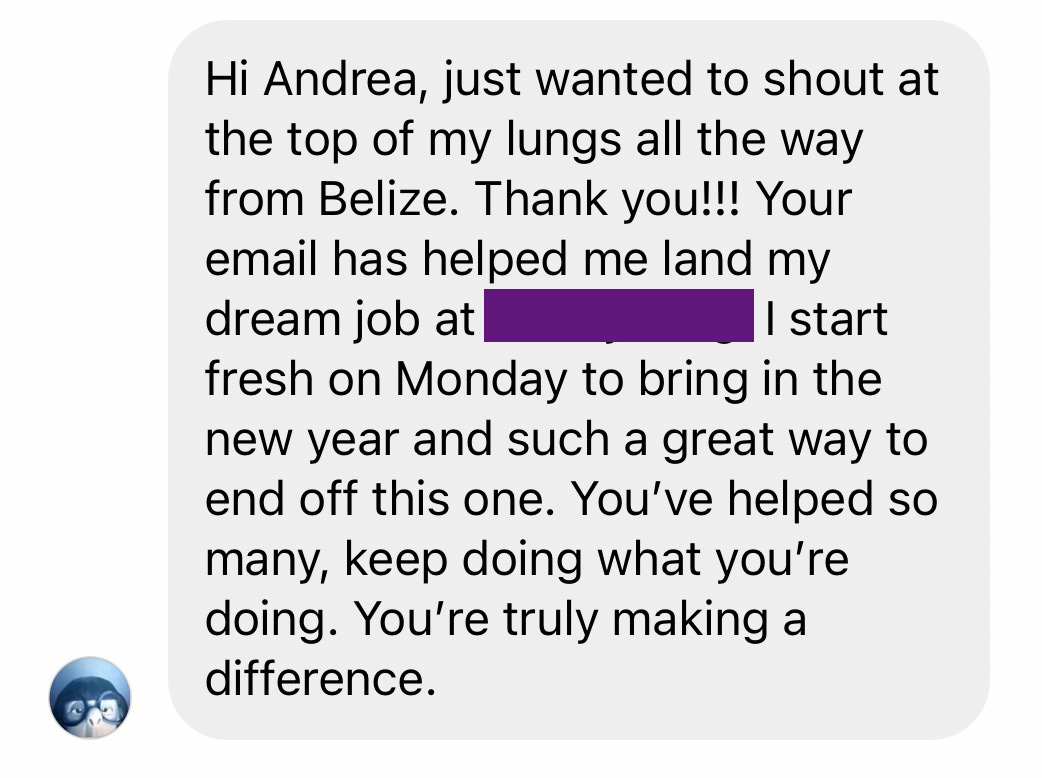
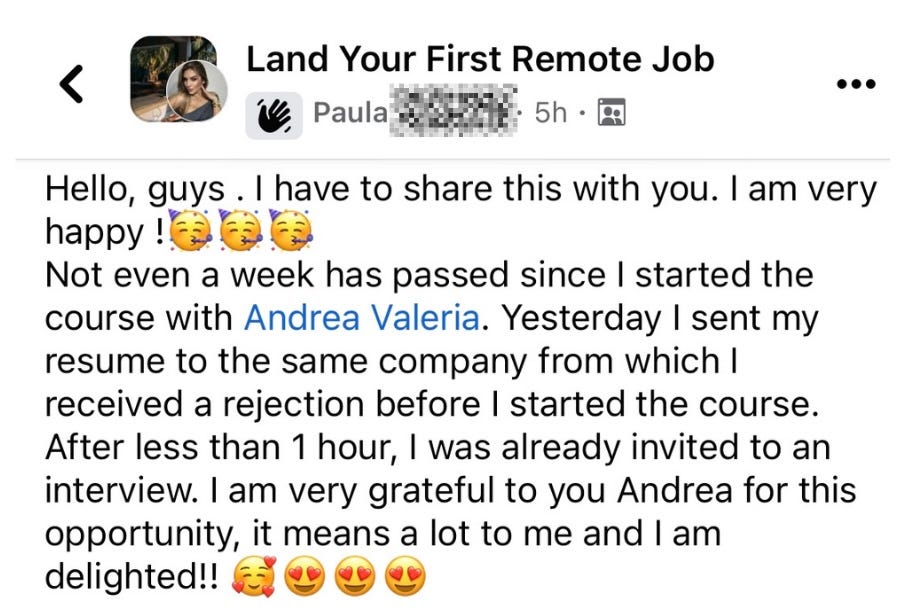
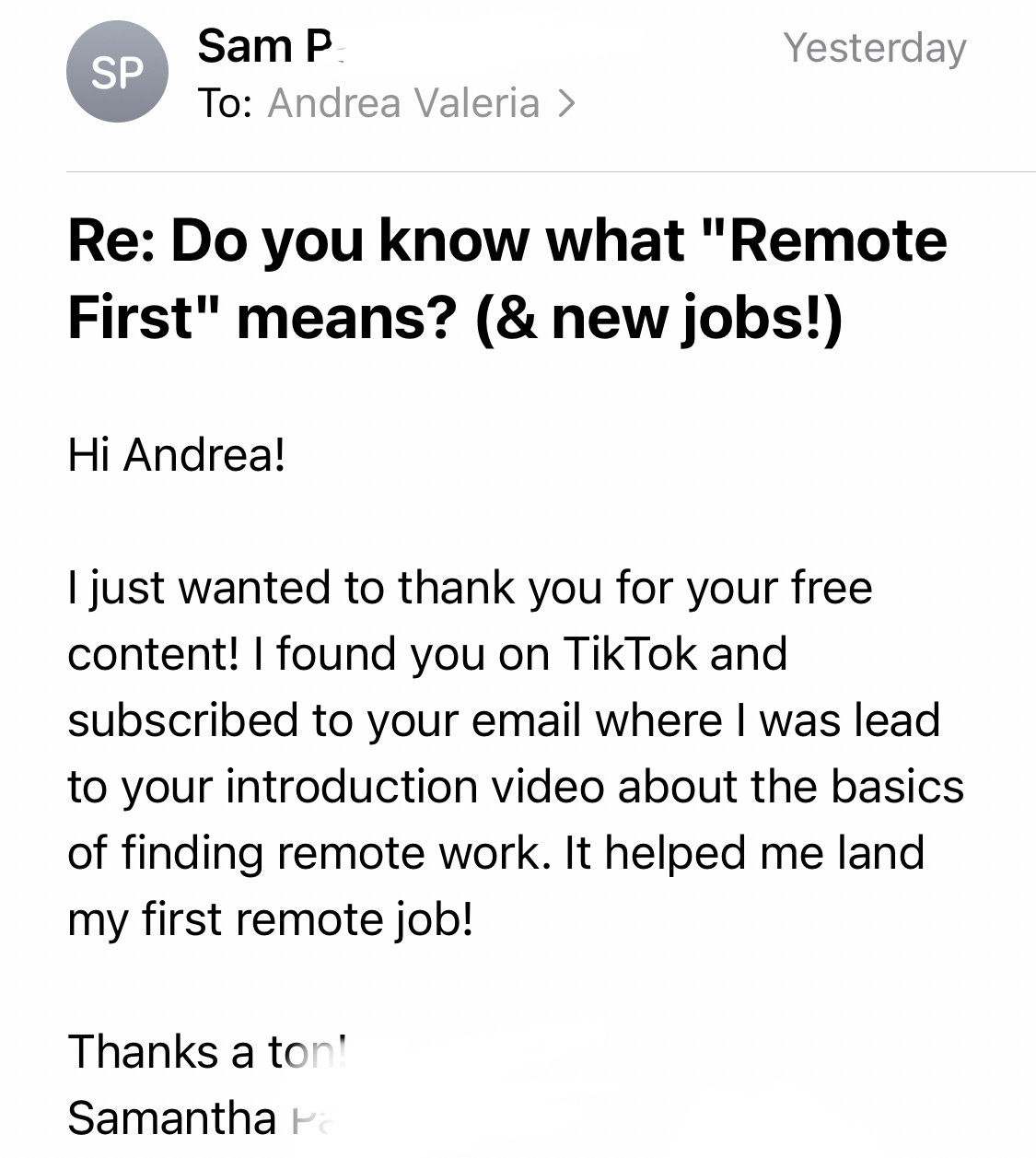
The funny part is that I get to see the impact of those resources all the time.
Sometimes someone emails me to tell me they got the job. Sometimes they send me an IG message months later. And sometimes I don’t hear anything... until years later.
A few weeks ago, I was in Toronto for the World Cup when someone stopped me.
He looked at me for a second and said, “You’re the remote work girl, right?”
Then he smiled and said something I’ll probably never forget.
“I got my remote job because of you.”
Of course, my first question was, “Did you ever tell me?”
He said no. This was the first time he had an actual interaction with me — online or in person. That conversation stayed with me for the rest of the day.
It reminded me that there are probably so many people I’ll never hear from.
People who found a job through my remote job directory. People who watched one YouTube video. People who stumbled across a newsletter, a Substack article or a free video training at exactly the right time. People who quietly changed their lives and simply moved on.
I think about that a lot. It reminds me that this work is so much bigger than numbers on social media.
When I first started talking about remote work, people thought I was talking about working from beaches and coffee shops.
Those things are fun, don’t get me wrong. I still love the freedom that remote work gives me, and I still occasionally do those things even though I’m not a digital nomad anymore. More on that HERE.
But after watching so many people land their first remote jobs, I’ve realized that’s not what remote work is really about.
It’s about getting your evenings back because you’re no longer spending two hours a day commuting.
It’s about finally being able to have breakfast with your family instead of rushing out the door.
It’s about taking your kids to school.
It’s about moving to a city you actually want to live in.
It’s about having enough flexibility to go to a doctor’s appointment without having to fill out a form.
It’s about not having to commute to work every day, and having more time for hobbies or working out or sleeping in.
It’s about better salary opportunities — that aren’t limited to where you live.
It’s about having an income while taking care of a sick loved one.
It’s about seeing an improvement in your mental health.
And so many other reasons, but I couldn’t possibly list them all here.
That’s why I’m so passionate about helping people get their first remote job though. You feel me?
Not because I think everyone should become a digital nomad. Def not.
Not because I think remote work is perfect and your first remote job will be a dream job. Nah, I’m realistic.
But because I’ve seen what one opportunity can do, and how it can start showing you all the possibilities and options you have. Making money online can start with a remote job, and eventually you’re out there also making money from affiliate marketing or writing articles on Substack like I’m doing here. By the way, here’s this article on the 32 ways I’ve made money online since I started working remotely back in 2015.
It certainly changed my life. I started seeing cool stuff happen from day 1 literally. I talk about that HERE.
And over the last few years, I’ve had the privilege of watching it change hundreds of other lives too.
If you’ve made it this far and you’re serious about finding your own remote job, I want to encourage you to keep going. Don’t convince yourself that you need another degree, a completely different career or years of additional experience before you can even try.
Start with what you already have.
I’m so sure you have more transferable skills than you think.
If you’re not sure where to begin, the next thing I’d recommend reading is The 3-Month Plan to Get a Remote Job.
What to Do in the Next 90 Days to Get a Remote Job (Exactly What I'd Do)

There’s a lot of noise online about how to land a remote job. Most of it is either super vague, overwhelming, or not realistic.
It’s one of the most comprehensive guides I’ve written, and it walks you through exactly what I would do if I were starting from scratch today. Instead of guessing what to focus on each week, you’ll have a clear roadmap that takes you from identifying your skills to applying strategically and landing interviews.
Because the hardest part isn’t getting a remote job.
It’s knowing where to start, and how you can avoid the common mistakes that delay actually getting that remote job.
Oh, and hopefully, after reading this article, you’re one step closer than you were before. That’s my goal. Thanks for being here!
💜
Andrea Valeria